
Perry Township Previous Residents Sources
The people previously connected to one Perry Township property will not be found in one master list. Land documents establish the ownership trail, while directories and census records can provide dated household clues. Start with the present parcel profile, preserve its PIN and legal description, and choose the next source from the time period. The Recorder holds land-document history from the county’s beginning in 1809, but the official web search does not state its earliest online year.
| Source | Years it covers | Where held | What it shows |
|---|---|---|---|
| Recorder land-document custody | From 1809; online cutoff unverified | Stark County Recorder and public search | Owners, legal descriptions, plats, encumbrances, and recorded instruments. |
| Early county tax index | 1810-1825, 1826-1829, and 1830 | Stark Library Index Files | Early landowner or tax-name leads, not a modern street address. |
| 1850 Stark County landowner map | 1850 | Library of Congress | Landowner and geographic context before directory coverage. |
| Canton City Directory | 1859-1930, noncontinuous | Stark Library digital archive | Printed residence, occupation, and address clues near the Canton/Perry fringe. |
| Probate estate files | Since 1810 on microfilm | Probate, Stark Library, and Akron repositories | Estates, fiduciaries, heirs, and property-administration leads. |
| Federal census | Public releases follow the federal 72-year rule | National Archives and library databases | A dated household snapshot that should be paired with land evidence. |
The Stark Probate historical-records resource identifies local estate, marriage, will, naturalization, and vital-record holdings that can extend a Perry Township address trail when a land record names an estate or fiduciary.
Historic probate material is an endpoint or corroborating source for an address trail, not proof that every named heir or relative lived at the property.
Perry Township Records Before Directories
For the oldest Perry Township address research, move from modern address language to land descriptions. Stark Library Index Files document early tax index segments for 1810 through 1825, 1826 through 1829, and 1830. The Library of Congress has an 1850 Stark County landowner map, and the library indexes a 1875 atlas and history. These materials locate landowners and places before the Canton directory title begins, but they are not a direct list of occupants at a current house number.
Save the lot, subdivision, acreage, or metes-and-bounds wording when an old record uses it. A legal description is the formal land wording carried in deeds and tax-map records. It survives better than a postal city, a ZIP code, or a street string when municipal labels change. The Stark County Tax Map Department works with plats, subdivisions, annexations, and legal-description review.
For older research, the Stark County Index Files can supply a documented volume or page lead before a request is made to a custodian. Community genealogy resources can help identify a source to consult, while official and institutional custodians remain the place to verify a record.
Tracing Perry Township Deed Records
The deed chain begins with the Stark County Real Estate Search. Locate the correct property by its site address and PIN, then record the current owner, legal-description lines, tax district, recent sale data, and map link. The tax mailing address may name an agent, trust, business, tax preparer, or nonresident owner. It is not proof that the owner lives at the situs, and the property card is reference material rather than the recorded instrument.
- Use the Auditor parcel profile to capture the current owner, PIN, subdivision or legal description, and the latest sale reference.
- Open the Stark Recorder Official Record Search and search the current deed through a party name, document number, date, or legal-description phrase.
- Record the grantor, grantee, recording date, instrument or book/page number, document type, and legal description from the deed index or image.
- Search the seller or earlier owner as a grantee or party in the preceding instrument, while testing the same legal description at every step.
- When the web trail ends, take the party, book/page, and legal-description notes to the Recorder counter, historic books or microfilm, Probate, Stark Library, or the archives.
- Grantor and grantee
- The grantor transfers an interest in a recorded instrument; the grantee receives it. The names identify roles in that document, not necessarily residence.
- Chain of title
- The sequence of recorded transactions that connects one owner or interest holder to an earlier one.
- Legal description
- The lot, subdivision, metes-and-bounds, or other land wording that links records even when an address changes.
The Recorder’s Quick Search offers a real-property department, party, subdivision, document-type or document-number terms, date controls, and index-only or index-plus-OCR choices. The current portal does not publish an earliest searchable date. Preserve that limitation rather than assigning a guessed online cutoff.
Perry Township Recorder Records Limits
Free online access is useful, but it is not the only Stark Recorder channel. The Recorder says documents are available through its website at no direct user cost, and the office counter at 110 Central Plaza South, Suite 170, Canton, offers help with older-index questions, certified needs, and documents that do not surface online. The listed telephone number is 330-451-7443, with weekday hours of 8:30 a.m. to 4:30 p.m.
The official fee information gives a useful contrast for house-history work: online images are free where available; self-service counter copies are 10 cents per page; staff copies are $2 per page; and certification is $1 per document. The record search is document-oriented, not a resident roster. Its older quick guide identifies columns for instrument number, book, page, recorded date, document type, name, other name, legal description, and marginal notes.
Perry Township Address Record Labels
Annexation, not a verified townshipwide renumbering, is the documented local address trap. The 2025 Perry Township comprehensive plan describes the township between Canton and Massillon and notes substantial municipal annexation, especially to Massillon. An old Perry Township address can therefore lead to a current Massillon, Canton, or Navarre municipal or postal label. Search the street, parcel, and legal description across the historic township and current municipality.
The plan reports Massillon annexations of 2,198.52 acres in the 1980s, 1,575.08 in the 1990s, 592.93 in the 2000s, and 148.69 in the 2010s, with smaller Navarre and Canton entries. Those figures explain why a city line or ZIP does not settle the identity of an old parcel. No official source located a Perry Township street-renumbering or renaming date, so no such date should be assumed.
The Perry Township comprehensive plan supplies the annexation and subdivision context that makes a parcel-first approach necessary.
Perry Township Household Record Clues
Ownership is only part of an address history. The Perry Township City Directory resource explains the Canton collection in detail, including its noncontinuous 1859 through 1930 title range and coverage limits. For an address-first lead, Stark Library says it uses the Canton Haines Criss+Cross Directory. Start in the relevant street or address section, identify the printed occupant or phone listing, then verify it in the alphabetical directory and a separate record.
- Choose a dated directory or criss-cross volume that matches the known property era, and record the volume, page, and address exactly.
- Pair that date with the appropriate public federal census release to identify a household snapshot rather than assuming the owner was the occupant.
- Check newspaper notices, an obituary, marriage, or probate record when the household changes, keeping the source date distinct from the event date.
- Return to the deed chain if the address wording differs, using the legal description to determine whether the records concern the same land.
Stark Clerk's Naturalization Search is one further historical index route. It supports name, arrival-year, origin-country, and vessel modes, so it can corroborate a family-history lead without establishing a person’s address on its own.
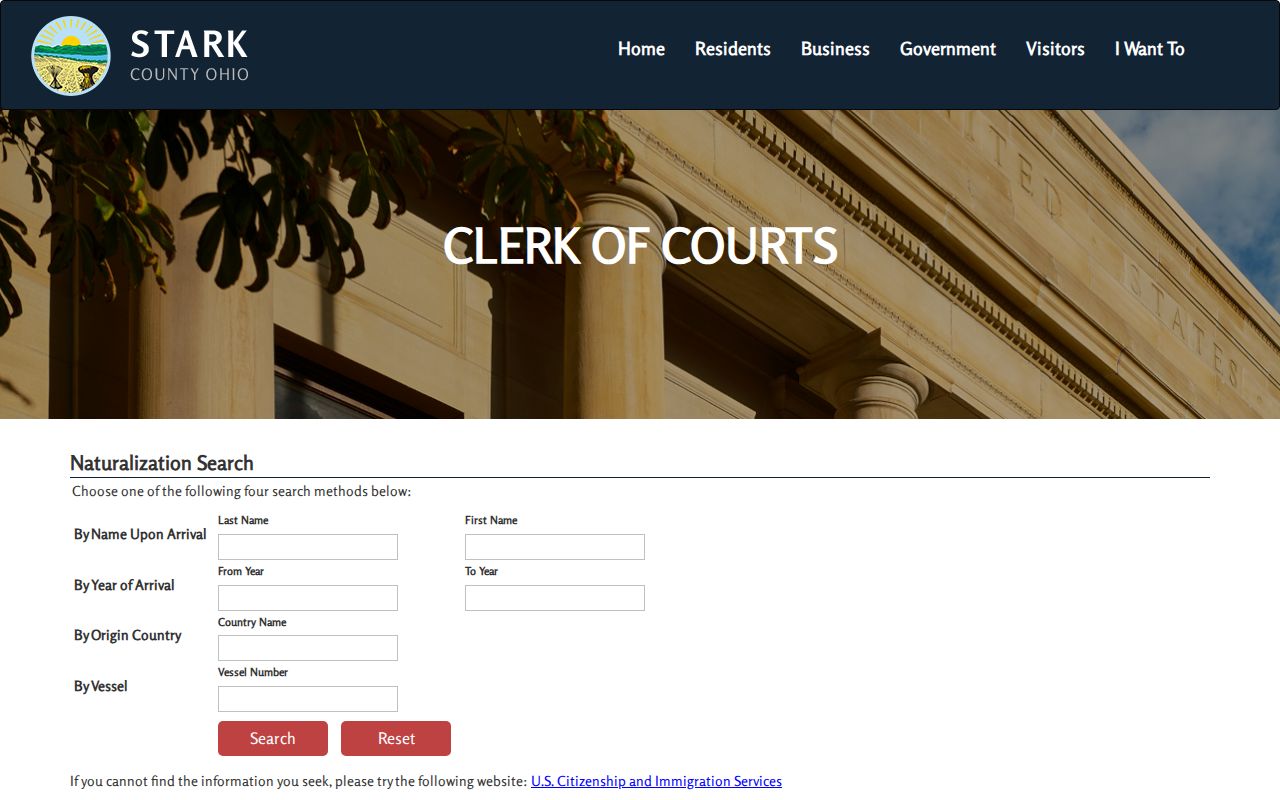
Naturalization results should be read as person and record-location clues, then connected to a Perry Township property only through dated address or land evidence.
Perry Township Probate Record Trail
Estate and marriage records can explain a household or ownership transition that a deed alone does not. Stark Probate reports estate case files since 1810 on microfilm. Its historical holdings include a marriage index from 1809 through 1972, marriage records from 1809 through 1916, will-index material from 1811 through 1942, and records held across Probate, Stark Library, and University of Akron repositories after the 1988 preservation transfer.
The Stark Probate marriage resource is a current custodian route for county marriage records. An application or marriage record can support identity and date research, but it should not be used to infer a private current location.
When an index gives a volume and page, ask the correct repository about its copy procedure rather than assuming every historical image is online.
Perry Township Historical Record Requests
No official Perry Township house-history guide was located. Stark Library’s documented alternative is its Genealogy Request Form and appointment channel. A useful request gives the present address, PIN or legal description, subdivision or lot if known, an approximate time window, and the owner names and dates already found. Ask for an existing index, map, directory, or record reference rather than a new story about the property.
The library allows one request per form, up to three each week, says digital copies are free, and ordinarily responds in two to three days. The Probate Records Center can show an in-person visitor how to use its indexes but does not perform general genealogy research. The Stark County Genealogical Society is a supplementary local research contact alongside those custodial channels.
Use a focused record request and keep its reply with the parcel notes, because a documented negative search is still useful when building a careful address history.